Hobby Farms in Cariboo: Land Requirements Guide
Hobby Farms, Cariboo, Small Acreage
Hobby Farms in the Cariboo: How Much Land Do You Actually Need?
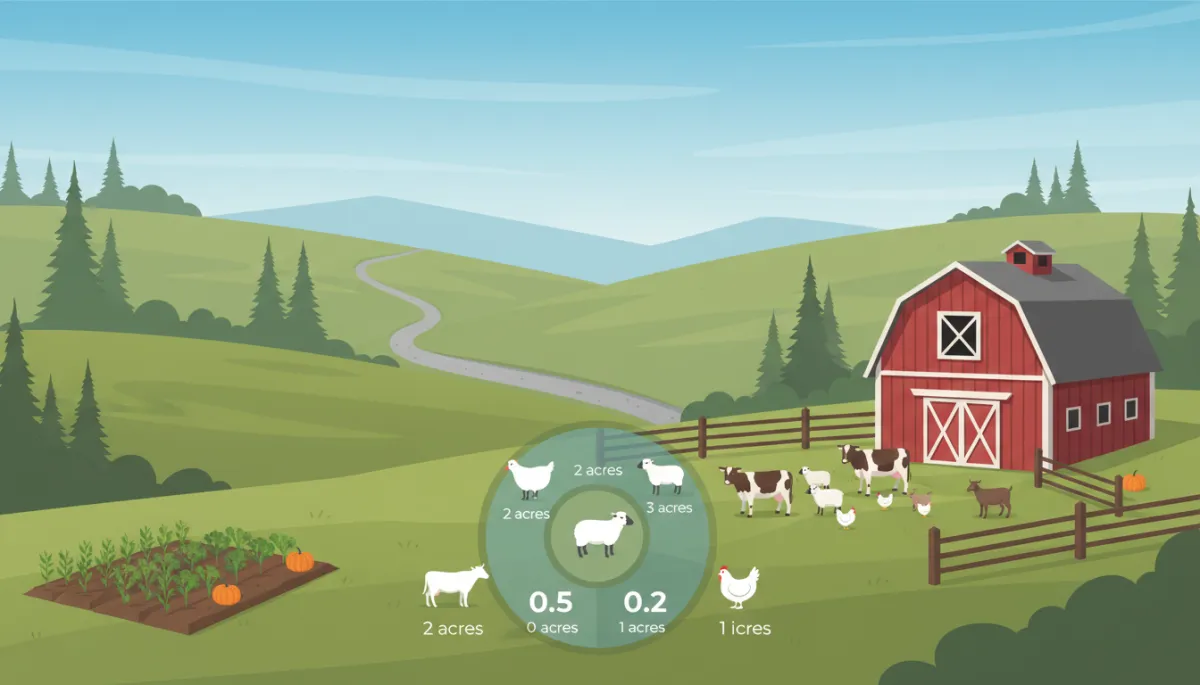
If you’re dreaming of a hobby farm in BC’s Cariboo, a practical starting point is about 4 hectares (10 acres). That size lines up with Cariboo Regional District guidance for viable hobby farms and subdivision policy, and it gives enough room for a mix of animals and gardens. As a rough rule of thumb, many Cariboo hobby farmers find that on 10 acres you can comfortably keep, for example: 5–10 laying hens (well under 0.25 acres), 2–4 goats on 0.25–0.5 acres of well-managed pasture plus shelter, 3–4 sheep on 1 acre, 1 cow–calf pair on 1–2 acres, 2–4 pigs on under 0.25 acres of yard plus housing, a family vegetable garden of 100–500 square feet, and a small berry patch or mini-orchard on 0.25–1 acre. The rest acts as rotation, hay, buffer, and space for driveways and buildings.
What Is a Hobby Farm in BC’s Cariboo?
A hobby farm is usually defined less by size and more by intent. In British Columbia, planning documents often treat hobby farms as small agricultural properties where farming is not the primary source of household income and gross farm receipts are modest. Provincial planning resources referenced by the Agricultural Land Commission (ALC) commonly associate hobby farms with annual farm receipts under about $2,500, distinguishing them from full commercial operations while still recognizing real agricultural activity.
In the Cariboo, that might look like a family with off‑farm jobs raising a few animals, growing vegetables, putting up hay for their own use, and maybe selling eggs or produce at a local market. The lifestyle focus is self‑reliance, food security, and rural living, rather than maximizing profit per acre.
Hobby Farm BC: How Land Size Connects to Tax and Zoning Rules
In British Columbia, including the Cariboo, the phrase “hobby farm BC” often comes up in two contexts: lifestyle and taxation. While anyone can call their small acreage a hobby farm, the BC Assessment Authority and the Ministry of Agriculture and Food use more precise criteria for farm classification (which can significantly reduce property taxes).
Under provincial regulation summarized on BC Assessment’s “About Farm Land Assessment” pages and in BC Laws, the required gross annual value at farm gate prices depends on parcel size:
Under 0.8 hectares (under ~1.98 acres): at least $10,000 in gross annual farm income.
0.8–4 hectares (~1.98–9.88 acres): at least $2,500 in gross annual farm income.
Over 4 hectares:$2,500 plus 5% of the land’s actual value beyond 4 hectares.
These thresholds are drawn from the Classification of Land as a Farm Regulation under the Assessment Act, administered with guidance from the Ministry of Agriculture and Food and BC Assessment. For a hobby farmer in the Cariboo, this means that if you want your small farm to qualify for farm classification, you’ll need to plan your acreage and production to realistically hit those income levels, or consider applying as a “developing farm” while you establish orchards, fencing, and infrastructure.
💡 Pro Tip: Before you buy, ask BC Assessment and the Cariboo Regional District planning department how your prospective property is currently classified and whether it lies in the Agricultural Land Reserve (ALR).
Cariboo Regional District Guidance: Why 4 Hectares (10 Acres) Is a Sweet Spot
Local planning policy matters just as much as provincial rules. A Cariboo Regional District (CRD) agricultural planning document notes that hobby farms are less likely to occur on parcels under 4 hectares. As a result, CRD often recommends a minimum lot size of 4 hectares (about 9.88 acres) for parcels expected to support hobby farm uses and to protect agricultural capacity in the long term. This recommendation also aligns with subdivision policies, where non‑ALR rural parcels typically must be at least 4 hectares to qualify for subdivision.
In practice, many Cariboo hobby farms sit in the 5–10 acre range, especially near communities where land prices are higher. This scale gives room for a small house, outbuildings, animal housing, gardens, access roads, and setbacks from neighbours, while still being manageable for a couple or family working mainly off‑farm.
How Much Land Do You Need for Different Animals and Crops?
The BC Ministry of Agriculture and Food provides broad land‑use planning guidance, while more detailed stocking rates often come from a mix of provincial resources and small‑farm best practices. The figures below are conservative, hobby‑scale estimates suitable for Cariboo conditions, where growing seasons are shorter and winter feed must be planned carefully.
Poultry and Small Livestock
Chickens: About 3–4 sq ft per bird indoors and 8–10 sq ft in an outdoor run. Even 10–20 layers can be managed on a tiny fraction of an acre, making chickens ideal for very small farms or 1–2 acre rural lots, subject to local bylaws.
Goats: Plan for at least 250 sq ft of yard space per goat plus shelter, and more if you want them on pasture. On a 10‑acre Cariboo hobby farm, 2–4 dairy or meat goats are very manageable if you supplement with hay.
Sheep: A common guideline is 0.5–1 acre for 3–4 sheep on reasonable pasture. In the Cariboo, where forage quality and snow cover vary, many small farmers keep stocking rates at the lower end and rely on purchased or home‑grown hay.
Larger Livestock and Pigs
Cattle: A widely used benchmark is 1–2 acres per cow–calf pair on decent pasture. In the Cariboo’s cooler climate, you’ll likely need the higher end of that range plus hay land. A typical hobby farm might keep one or two cows on 10 acres, especially if you also have other livestock.
Pigs: Around 20 sq ft per pig indoors and 100 sq ft outdoors is a common minimum. Two to four pigs for home meat can be raised on a small yard area, but they are hard on soil, so many Cariboo hobby farmers rotate them through sacrificial paddocks and plan for mud management.
Vegetables, Fruit, and Grains
Vegetable garden: A productive family plot can start at 100–200 sq ft and scale up to 400–500 sq ft or more if you want to preserve food. Raised beds and season extension are especially valuable in the Cariboo’s shorter growing season, as highlighted in BC Ministry of Agriculture planning resources.
Fruit and berries: A mini‑orchard and berry rows typically use 0.25–1 acre, depending on spacing and species. Apples, haskaps, and hardy berries can do well with thoughtful site selection and frost protection.
Grains: One acre of small grains (wheat, barley, oats) can supply a family’s basic needs, but equipment and labour can be limiting for hobby farmers. Many Cariboo smallholders instead grow forage crops or buy grain locally.
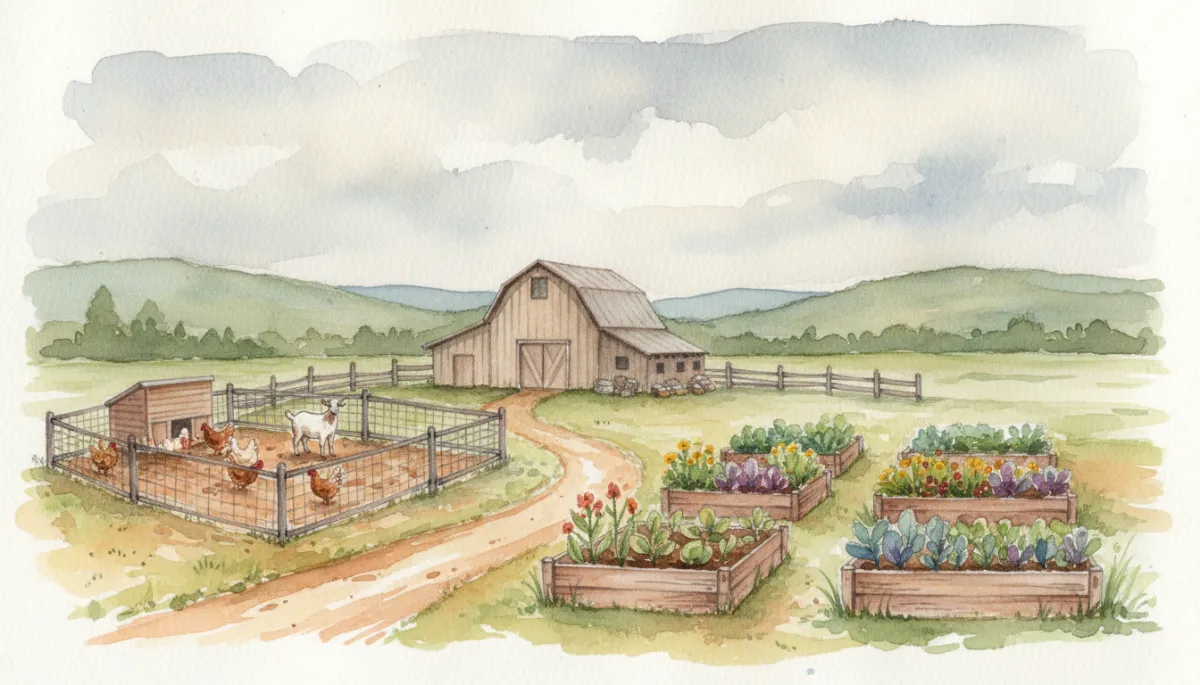
Thoughtful layout lets a 10 acre Cariboo hobby farm support diverse animals and crops.
How Much Land Is Needed for a Small Farm vs. a Hobby Farm?
When people ask, “How much land is needed for a small farm?” they’re often imagining something between a backyard garden and a full‑scale ranch. In the Cariboo, a small farm that aims to generate meaningful income might start around 10–40 acres, especially for livestock and hay. Larger acreages (80+ acres) are common for serious cattle or forage operations, as noted in regional agricultural adaptation reports for the Cariboo, where some farms extend to thousands of acres.
A hobby farm, by contrast, is more about lifestyle than income. With careful planning and supplemental feed, you can maintain a satisfying mix of animals and crops on as little as 2–5 acres, though you may not qualify for farm tax classification and you’ll have limited room for expansion. If your goal is a resilient, flexible property that can support a few larger animals, a generous garden, and possibly farm‑class status, the 4‑hectare (10‑acre) benchmark used by the Cariboo Regional District is a realistic and popular target.
Pulling It Together: Designing Your Cariboo Hobby Farm
Starting with around 10 acres in the Cariboo allows you to:
Keep a modest herd or flock (e.g., a cow–calf pair, 3–4 sheep, a few goats, and poultry) within commonly recommended stocking rates.
Establish a productive vegetable garden and small orchard using BC Ministry of Agriculture land‑use planning best practices.
Leave room for hay fields, shelterbelts, driveways, and manure management that meet environmental and zoning expectations.
Potentially reach the income thresholds needed for provincial farm classification, if you choose to sell products.
Ultimately, the “right” acreage for a hobby farm in the Cariboo depends on your goals, budget, and willingness to manage animals through long winters. Use the 4‑hectare guideline, BC Assessment’s farm‑class thresholds, and Ministry of Agriculture land‑use resources as a framework then scale up or down based on the mix of animals and crops that fits your life.
Related Reading: Cariboo Acreage & Hobby Farm Guides
Buying Small Acreages in the Cariboo: Zoning, Wells, and Septic Basics What to check before you write an offer on rural property.
Cariboo Climate 101: Growing Seasons, Frost Dates, and Garden Planning Plan your beds, tunnels, and varieties for shorter seasons.
From Pasture to Pantry: Starter Livestock Options for Cariboo Hobby Farms Compare chickens, sheep, goats, and cattle for new smallholders.
Understanding the Agricultural Land Reserve (ALR) in the Cariboo How ALR rules affect building, subdivision, and farm use contact Amanda to talk through your specific property plans.
Amanda Oldfield Realtor - eXp Realty
96 Hwy 97, 100 Mile House, BC
250-318-5202