Hobby Farms in Cariboo: Land Requirements Guide
Hobby Farms, Cariboo, Acreage Planning
Hobby Farms in the Cariboo: How Much Land Do You Actually Need?
If you are dreaming of a Cariboo hobby farm, a practical starting point is 4–10 acres for a mixed operation: roughly 1.5–2 acres per cow–calf pair, 0.5–1 acre per 4–6 sheep or goats, about 0.25–0.5 acre of intensive vegetables, and 0.5–1 acre of small fruit, plus space for buildings and driveways. These figures draw on stocking-rate and crop-production guidance from the BC Ministry of Agriculture and Food and are scaled to the Cariboo’s shorter growing season and variable pasture quality.
Why “How Much Land?” Depends on the Cariboo, Not Just a Number
Unlike some jurisdictions, the BC Ministry of Agriculture and Food does not publish a single “recommended acreage for hobby farms.” Instead, the Ministry provides stocking-rate and crop-production guidelines that you can translate into acreage based on your goals, soil, water, and the Cariboo’s climate. Meanwhile, the Agricultural Land Commission (ALC) and BC Assessment set thresholds for subdivision and farm tax classification, but these are regulatory—not lifestyle—benchmarks.
In practice, most Cariboo hobby farms that feel “comfortable but manageable” tend to fall between 4 and 10 acres. Below that, you may struggle with pasture in dry years; much above that, mowing and fencing alone can become a part‑time job unless you scale up production.
Recommended Acreage by Animal Type (Based on BC Guidance)
The BC Ministry of Agriculture’s livestock resources outline typical pasture requirements and stocking densities for British Columbia’s regions, which can be adapted to the Cariboo’s interior conditions (cool winters, relatively dry summers). While not branded as “hobby farm” tables, they function as de‑facto acreage recommendations by operation type.
Animal / Operation Typical Cariboo-Scaled Acreage Source Basis Cow–calf pair (seasonal grazing) 1.5–2 acres per pair of well‑managed pasture BC Ministry of Agriculture livestock & pasture guidelines for interior regions Beef or dairy replacement heifer Around 1–1.5 acres per head Derived from Ministry stocking‑rate examples for smaller cattle Sheep or meat goats (small flock) 0.5–1 acre per 4–6 animals, rotationally grazed BC sheep & goat management notes on carrying capacity Pigs (pasture + dry lot) 0.25–0.5 acre for 2–4 pigs plus sturdy pens Ministry small‑lot livestock and environmental farm planning guidance Laying hens or meat birds 0.1–0.25 acre for 25–50 birds (coops + runs) Ministry poultry housing & range recommendations
These figures assume you are buying in hay and grain for winter, which is common for Cariboo hobby farms. If you want to produce most of your own winter feed, you will need significantly more acreage for hay fields and crop rotation.
Recommended Acreage by Crop Type for a Cariboo Hobby Farm
The BC Ministry of Agriculture’s crop production guides provide expected yields per acre for vegetables, forage, and tree fruits across the province. Translating those into hobby‑farm scale in the Cariboo gives you realistic land‑use targets rather than guesswork.
Intensive mixed vegetable garden: The Ministry’s vegetable production data show that well‑managed plots can easily supply a household on 0.1–0.25 acre. For a small CSA or farm‑gate stand, aim for 0.25–0.5 acre of beds, plus paths and wash/packing space.
Potatoes and storage crops: Provincial yield targets of roughly 20,000 lb of potatoes per acre suggest that 0.1–0.2 acre is plenty for a family’s winter supply, allowing for Cariboo weather variability.
Small fruit (berries, hardy bush fruits): Ministry fruit guides commonly work on densities of 200+ plants per acre. A 0.25–0.5 acre berry patch can provide ample fresh fruit and some jam or sales, provided you have irrigation.
Hay or forage: For interior BC, Ministry forage bulletins indicate that a single acre of productive hay field can support roughly one cow–calf pair for 1–2 winter months. To overwinter your own cattle on home‑grown hay, plan several acres per animal.
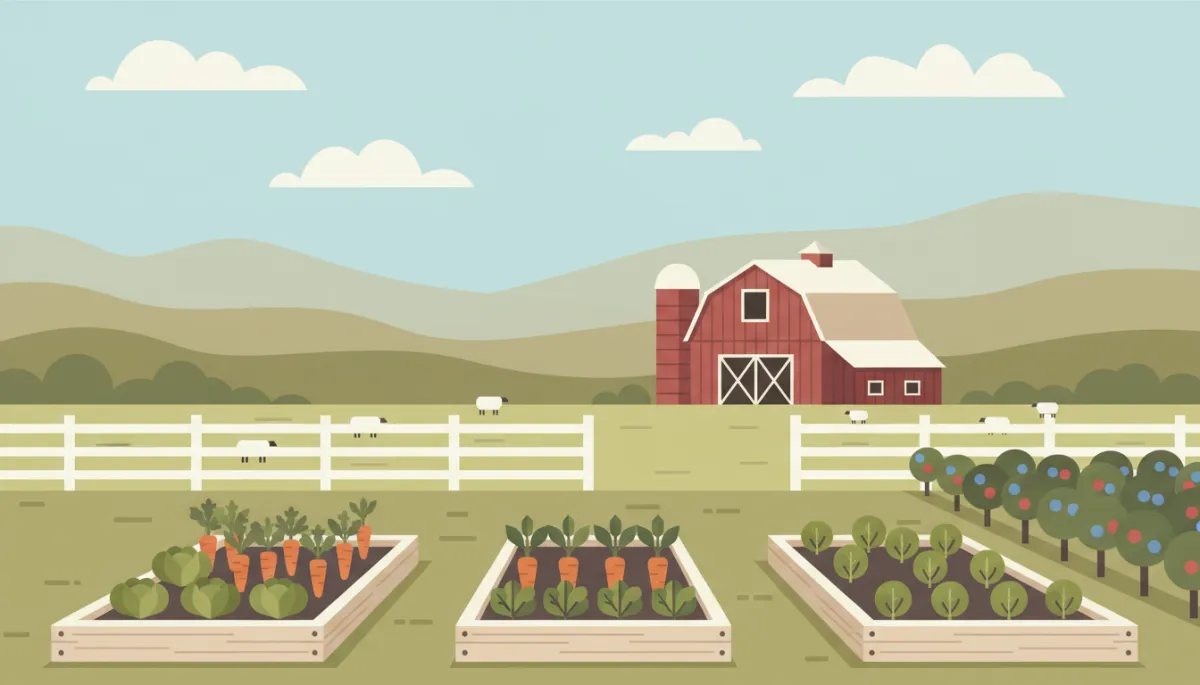
Even a half-acre of well-planned gardens and berries can feed a family and neighbors.
How BC Policies Shape Practical Minimums in the Cariboo
While the Ministry does not dictate a “hobby farm size,” provincial and regional rules do influence what feels practical. The Cariboo Regional District frequently uses 4 hectares (about 10 acres) as a minimum lot size in rural zones, and the Agricultural Land Commission tightly controls subdivision within the Agricultural Land Reserve. For tax purposes, BC Assessment requires farms between 0.8 and 4 hectares to generate at least $2,500 in qualifying agricultural income to receive farm classification.
Put together, these Ministry and agency guidelines imply that a 4–10 acre parcel offers a sweet spot: large enough to support a few livestock, gardens, and perhaps some berries, yet small enough to manage on evenings and weekends without needing full‑scale equipment or a hired hand.
💡 Pro Tip: Start your land search by listing your “must‑have” animals and crops, then add up the Ministry‑based acreage estimates for each. Add at least 20–30% extra for laneways, buildings, setbacks, and future expansion.
Pulling It Together: Sample Cariboo Hobby Farm Layouts
Using BC Ministry of Agriculture livestock and crop guidance as a foundation, here are two realistic Cariboo scenarios:
Compact 4–5 acre starter farm: 1 cow–calf pair (2 acres pasture), 6–8 sheep or goats (1 acre), 0.25 acre of vegetables, 0.25 acre of berries, plus buildings and yard. Hay is purchased locally; you focus on grazing, eggs, and produce.
Spacious 8–10 acre homestead: 2–3 cow–calf pairs, 10–12 sheep or goats, 0.5 acre in vegetables, 0.5 acre in berries, and several acres of hay field. With good management, this can approach self‑sufficiency and meet BC Assessment farm‑income thresholds through farm‑gate sales.
Final Thoughts: Choose Land That Matches Your Time, Not Just Your Dreams
The BC Ministry of Agriculture and Food does not hand hobby farmers a simple acreage chart, but its livestock stocking‑rate and crop yield resources make it possible to plan responsibly. In the Cariboo, where winters are long and summers can be dry, those guidelines translate into a clear rule of thumb: 4–10 acres is usually enough for a satisfying, sustainable hobby farmprovided you match your animals and crops to what the land and your schedule can realistically support.
Before you buy, cross‑check any property with ALR maps, Cariboo Regional District zoning, and the BC Ministry of Agriculture livestock and crop guides. That way, your Cariboo dream acreage will be grounded in both inspiration and solid provincial science.