Guide: Negotiate Rural Property in Slow Market
Real Estate, Rural Property, Negotiation
16 Buying/Selling Guide: How to Negotiate on a Rural Property in a Slow-Moving Market
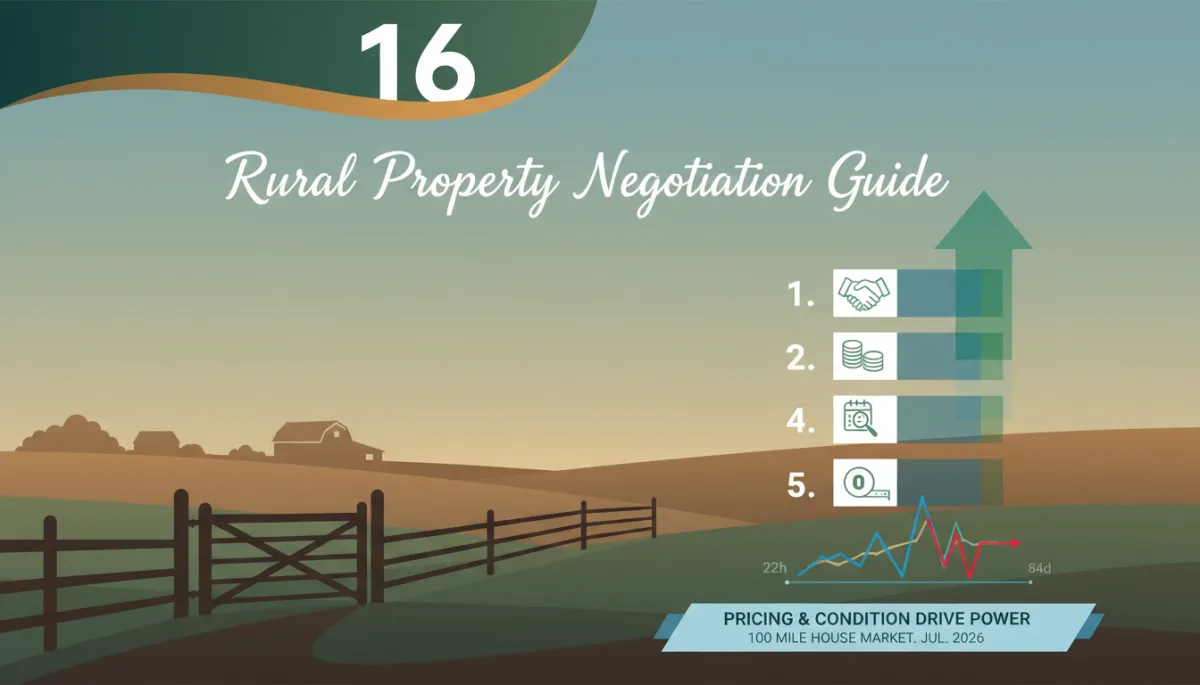
In a slow-moving rural market, your negotiating leverage comes from three main places: days on market, pricing versus recent sales, and property condition and usability. In 100 Mile House, for example, recent listing data shows rural-style properties sitting anywhere from 22 hours to 84 days before going under contract, a spread that clearly illustrates how well-priced, turnkey homes move quickly while overpriced or dated listings linger (Source: 100 Mile House listings, Jul. 2026). If you are a buyer, the longer a property has been listed and the more work it needs, the more room you typically have to negotiate. If you are a seller, sharp pricing and clean presentation are your best tools to protect your price in a market where buyers have options and time on their side.
Why Slow-Moving Rural Markets Create Opportunity
Rural markets like 100 Mile House can experience long stretches of limited sales activity. In July 2026, for example, there were zero recorded home sales and zero new listings, but still dozens of active properties on the market, signalling a clear imbalance between supply and demand (ovlix.com; bcnreb.bc.ca; creastats.crea.ca). Earlier in the year, homes that did sell in the area took an average of 49 days to move, with individual listings ranging widely from just a few weeks to more than three months (bcnreb.bc.ca; wahi.com). Against that backdrop, the observed 22-hour to 84-day days-on-market spread in recent 100 Mile House listings shows that buyers and sellers are not negotiating in a vacuum they are negotiating against the realities of price, condition, and patience.
📌 Key Takeaway: In a slow rural market, time on market is a loud signal. Quick sales usually mean a sharp price and good condition; long listings often mean room to negotiate.
16 Negotiation Tactics for Rural Buyers and Sellers
Anchor Your Strategy in Days on Market
Use the 22-hour to 84-day spread in 100 Mile House as a benchmark. As a buyer, push harder on price and terms once a listing passes the local average of roughly 49 days (bcnreb.bc.ca). As a seller, price realistically from day one to avoid drifting into the “stale listing” category where buyers expect discounts. (Source: 100 Mile House listings, Jul. 2026; bcnreb.bc.ca)Research Comparable Rural Sales, Not Just List Prices
In thin rural markets, list prices can be aspirational. Focus on recently sold acreages, hobby farms, and detached homes with similar land size, access, and outbuildings. Use provincial and board statistics like Q2 2026’s median price of about $560,000 in the wider area—to frame whether the asking price is realistic (creastats.crea.ca; bcnreb.bc.ca).Leverage Property Condition and Usability
Septic age, well performance, fencing, driveways, and outbuildings all affect value. Buyers can negotiate price reductions or repair credits when systems are near end-of-life or poorly documented. Sellers who service, inspect, and present these features clearly can justify firmer pricing even in a slow month like July 2026, when buyers know they have options.Understand Zoning, Water Rights, and Restrictions
Rural properties live or die by what you can legally do on them. Buyers should investigate zoning, agricultural designations, water licences, and easements early. If restrictions limit farming, short-term rentals, or additional dwellings, use that to negotiate a lower price. Sellers can pre-empt objections by providing zoning summaries and confirming permitted uses (landhub.com; farmanddairy.com).Price Strategically for the First 30 Days
The 22-hour end of the days-on-market range shows that the best-priced properties still move fast, even in a quiet month. Sellers should set a list price that is clearly competitive with recent sales, not just other listings, to attract the limited pool of active buyers quickly and avoid drifting toward that 84-day mark where buyers expect concessions.Use Time Flexibility as a Tradeable Chip
In rural areas, sellers may be coordinating livestock, equipment, or a move to another province. Buyers who can offer flexible closing dates, rent-back arrangements, or staged possession can often secure a better price in return. Sellers can ask a slightly higher price if they are willing to provide the buyer with a convenient possession timeline or early access for improvements.Get Pre-Approved and Show Proof of Funds
In a market with few completed sales, sellers worry about deals falling apart. Buyers who arrive with pre-approval letters and clear down-payment documentation have more leverage to negotiate on price, repairs, or included equipment such as tractors, wood splitters, or livestock shelters (realtor.com; farmanddairy.com).Ask About the Seller’s Real Motivation
Is the seller relocating for work, downsizing, or offloading an inherited property? In a slow month like July 2026, some owners may be carrying two mortgages or tired of managing vacant land. Buyers can tailor offers such as quick closings or fewer contingencies to match those needs. Sellers should share just enough context to show they are serious, without signalling desperation (landhub.com).Use Detailed Inspections as Negotiation Fuel
Beyond standard home inspections, rural buyers should consider well flow tests, septic inspections, soil testing, and surveys. Any negative finding low flow, undersized septic, encroachments can justify a price adjustment or seller-funded repair. Sellers who proactively complete and share these reports can reduce last-minute renegotiations and protect their net price.Negotiate for Equipment, Timber, and Miscellaneous Assets
Rural properties often come with tractors, implements, fuel tanks, stacked firewood, or merchantable timber. Buyers can bridge a price gap by asking for more inclusions instead of a lower price. Sellers can hold firm on price but sweeten the deal by including certain equipment or agreeing to leave seasoned firewood or fencing materials behind.Be Precise With Contingencies, Not Overly Demanding
In a slow market, buyers may be tempted to load offers with broad “escape hatches.” A better strategy is targeted contingencies financing, inspections, water quality, and zoning confirmation tied to specific time frames. Sellers are more likely to accept a lower price when the path to firming up the deal is clear and time-limited.Use Local Rural Agents and Data
A local agent familiar with 100 Mile House and surrounding communities will know which listings have quietly reduced prices, which have failed to sell before, and how long typical acreages sit on the market. That insight combined with board data showing fewer sales but steady prices helps you calibrate how aggressively to push (bcnreb.bc.ca; creastats.crea.ca).Present Offers Professionally and With a Clear Rationale
Whether you are asking for $20,000 off or defending your full-price listing, explain why. Reference comparable sales, days on market, inspection findings, and needed upgrades. In a slower rural market, reasoned arguments often succeed where blunt lowballing fails, especially with long-time owners who are emotionally attached to their land.Negotiate Closing Costs and Small Line Items
If price becomes a sticking point, shift to other levers: who pays for well testing, septic pumping, survey updates, or property transfer tax adjustments. In a slow month with no recorded sales, a seller may agree to cover several thousand dollars in closing costs rather than reduce the headline price, or a buyer may accept the price but ask for specific credits on the statement of adjustments.Be Ready to Walk Away Especially as a Buyer
With 97 active listings and no sales in July 2026 in 100 Mile House (ovlix.com), buyers are not under the same pressure as in a hot urban market. If a seller will not budge on an obviously above-market price, your strongest negotiating move may be to step back and let time work in your favour as their days-on-market counter keeps climbing.For Sellers: Re-Set the Narrative if Your Listing Stalls
If your acreage has been sitting closer to 84 days than 22 hours, it is time to adjust. Consider a meaningful price reduction, fresh photography, minor repairs, and a new marketing push. Publicly visible changes send a signal to buyers that you are serious, which can restart stalled negotiations and bring in offers that previously seemed out of reach.

Clear data, realistic pricing, and respectful dialogue turn rural negotiations into win–win deals.
Bringing It All Together in 100 Mile House and Beyond
The current 100 Mile House market few recent sales, dozens of active listings, and a striking 22-hour to 84-day days-on-market spread shows how pricing and condition directly shape negotiating power (Source: 100 Mile House listings, Jul. 2026; ovlix.com; bcnreb.bc.ca). Buyers should lean on time, data, and due diligence to secure fair terms. Sellers should lean on realistic pricing, strong presentation, and flexibility. In a slow-moving rural market, you cannot control the overall pace but with the right tactics, you can absolutely control how effectively you negotiate within it.