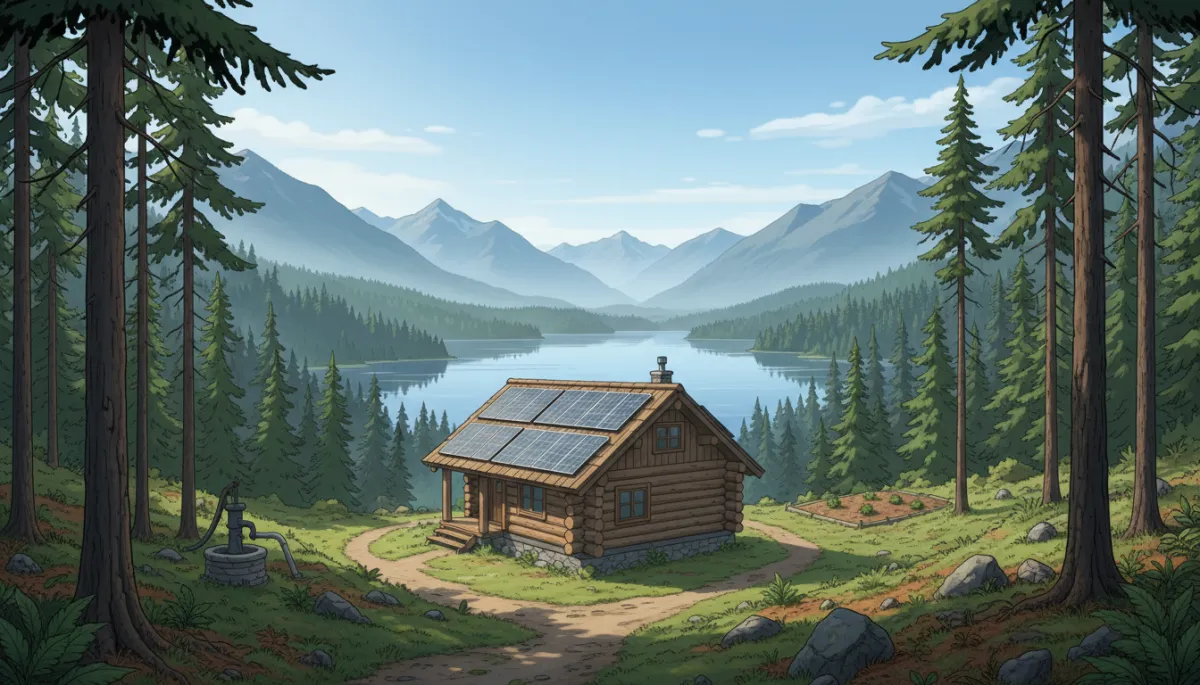
Off-Grid Cabin Land Requirements in BC
Off-Grid Living, British Columbia Land Use
How Much Land Do You Really Need for an Off-Grid Cabin in BC?
Short numeric answer: plan on at least 2 hectares (about 5 acres) for a practical, regulation‑compliant off‑grid cabin in most of rural BC, even though the provincial legal minimum without services is only 0.17 hectares (18,000 ft²). The extra space gives you room to meet well and septic setbacks, orient solar properly, and avoid crowding the neighbours.
1. The Legal Floor: Provincial Minimum Parcel Size in BC
British Columbia’s Subdivision Regulations under the Local Services Act set a province‑wide minimum parcel size when there is no community water or sewer service the situation for most off‑grid cabins. Where both services are absent, the minimum lot size is 18,000 ft² (about 1,672 m², or 0.17 hectares). [BC Reg 262/70]
This provincial rule is a baseline only. Regional districts and municipalities can and often do require larger minimum parcel sizes through their zoning bylaws, especially for rural or recreational cabin zones. For example:
Thompson‑Nicola Regional District “LA‑1 Limited Access Cabin Zone”: 2 hectares minimum parcel size for seasonal, off‑grid cabins.
Alberni‑Clayoquot Regional District (draft cabin policy): about 2 hectares per cabin as a planning guideline.
Regional District of Fraser‑Fort George: minimum subdivision parcel size of 6 hectares in many rural zones.
📌 Key Takeaway: You could legally subdivide to about 0.17 ha under provincial rules, but most rural cabin‑friendly zones in BC expect something closer to 2 ha or more.
2. Well Yield: Why Water Space Matters More Than You Think
For an off‑grid cabin, a reliable well is often your only long‑term water source. While BC does not prescribe a specific minimum yield for private domestic wells, many practitioners treat about 1.5–2 US gallons per minute as a practical lower bound for comfortable year‑round use, assuming you also have storage.
The catch is that provincial sewerage rules dictate how close your septic system can be to that well. Under BC’s Sewerage System Regulation, new systems must keep at least 30 metres (≈100 ft) between any septic dispersal field and a domestic water well. [BC Reg 326/2004] Holding tanks have a reduced, but still significant, minimum separation of 15 metres.
💡 Caveat: If your cabin site has poor groundwater or fractured bedrock, a driller may recommend even more space between well and septic to protect water quality, effectively making very small lots impractical.
3. Septic Setbacks: How They Eat Up a Small Lot
A conventional onsite sewage system needs clear space, not just for the tank and field, but also for regulatory setbacks. Under provincial standards and guidance (including historic SSR Schedule 2 and current practice), you typically need to maintain at least:
30 m from a domestic water well (new systems).
Around 3 m from parcel boundaries and buildings for many small systems (older SSR Schedule 2 guidance).
About 30 m from lakes, streams, or other surface water in many cases.
On a tiny 0.17 ha lot, the 30 m well‑to‑septic separation alone can dominate the entire site, especially once you add distance from property lines, driveways, and rock outcrops. This is a key reason why many regional districts push for larger rural lots than the provincial minimum.
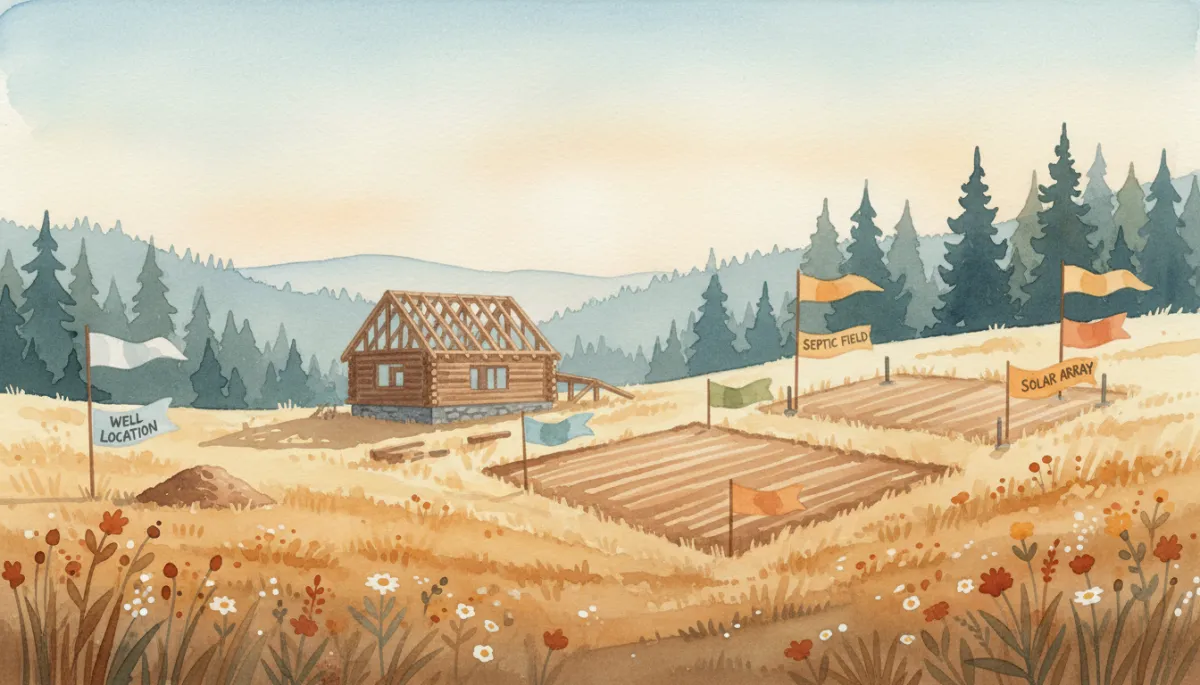
Once you map real setbacks, lots under about 2 hectares feel surprisingly tight.
4. Solar Exposure: Room to Chase the Sun (and Avoid Shade)
BC doesn’t have a province‑wide rule tying solar panels to wells or septic. There are no specific provincial setbacks between a solar array and a septic field as of 2026; any limits usually come from local zoning (for example, height‑based setbacks from property lines or visual impact rules).
Practically, though, an off‑grid cabin needs a south‑facing, unshaded area large enough for your panels, plus room to avoid shading from trees, outbuildings, and terrain. On a sub‑acre parcel, you may be forced into a compromised location with winter shading or difficult snow management. A 2 ha lot gives you flexibility to:
Clear a modest solar “window” without clear‑cutting the entire property.
Site panels away from heavy snow‑drift zones and falling‑branch risk.
Keep solar infrastructure visually and physically separate from your well and septic area.
💡 Caveat: Some municipalities and regional districts have specific rules for ground‑mounted solar (height limits, setbacks, or screening). Always check your local zoning before committing to an array location.
5. Cariboo Regional District: What the Current Bylaws Say
If you are cabin‑shopping in the Cariboo, you fall under the Cariboo Regional District (CRD), which governs zoning through a suite of area‑specific bylaws rather than a single “Zoning Bylaw 2026.” As of the latest consolidated documents (up to at least September 2025 and subsequent 2025–2026 amendments), zoning is still controlled by bylaws such as:
Bylaw 3501 – South Cariboo Area Zoning (Electoral Areas G, H, L).
Bylaw 3500 – Chilcotin Rural Land Use; Bylaw 3502 – Williams Lake Fringe & 150 Mile House; Bylaw 3503 – Central Cariboo Rural Land Use; Bylaw 3504 – Quesnel Fringe; Bylaw 3505 – North Cariboo Rural Land Use.
In 2025–2026, CRD adopted several amendment bylaws (for example, Bylaw 5546, 2025 and others through 2026), but these tweak zoning on specific parcels rather than creating a new, unified “2026” zoning bylaw. The practical implication for you:
Minimum parcel size and cabin permissions vary by Electoral Area and zone (e.g., Rural 1 vs Rural 2, resource, or lakeshore zones).
Some zones may allow small existing lots to be used for cabins but prohibit further subdivision below a larger minimum (often 2 ha or more).
⚠️ Verification Caveat: Before buying or publishing specific lot‑size advice for the Cariboo, always:
Confirm the current zoning bylaw and amendments for your exact Electoral Area on the official CRD website’s bylaw directory.
Call CRD Planning to verify minimum parcel size, permitted uses, and any site‑specific restrictions for off‑grid or recreational cabins.
6. Pulling It Together: How Much Land Should You Aim For?
When you blend the legal framework with the practical realities of off‑grid living, a clear pattern emerges:
Absolute provincial minimum: 0.17 ha (18,000 ft²) where no community water or sewer exists. This is a legal floor, not a comfort guideline.
Common rural zoning minimums: 2 ha in many cabin‑oriented zones; 6 ha in some northern or resource districts.
Functional off‑grid comfort zone: around 2–4 hectares gives you room for a good well location, safe septic setbacks, a decent solar window, fire‑smart defensible space, and future add‑ons like a workshop or guest bunkie.
So while you can legally get by with much less, a realistic target for most buyers is: at least 2 hectares (≈5 acres) for an off‑grid cabin in BC, checking that:
The zoning allows a cabin and matches your intended use (seasonal vs full‑time).
There is space to meet well and septic setbacks under current provincial rules and local health authority expectations.
You have a viable solar exposure window that won’t be shaded out by terrain or neighbouring lots.
7. Final Caveats Before You Buy
Regulations change, and site conditions vary wildly across BC’s mountains, plateaus, and lake country. Before committing to a parcel:
Verify the current provincial rules on subdivision, sewerage, and water wells on BC Laws.
Confirm the exact zoning bylaw and minimum parcel size with the relevant regional district (for the Cariboo, via the CRD bylaw directory and planning staff).
Engage a registered onsite wastewater practitioner and, ideally, a well driller or hydrogeologist to assess whether your preferred building spot can satisfy setbacks and still leave room for solar.
With that due diligence and a realistic land size of around 2 hectares or more you’ll give your off‑grid cabin the space it needs to function well, stay legal, and feel genuinely free.