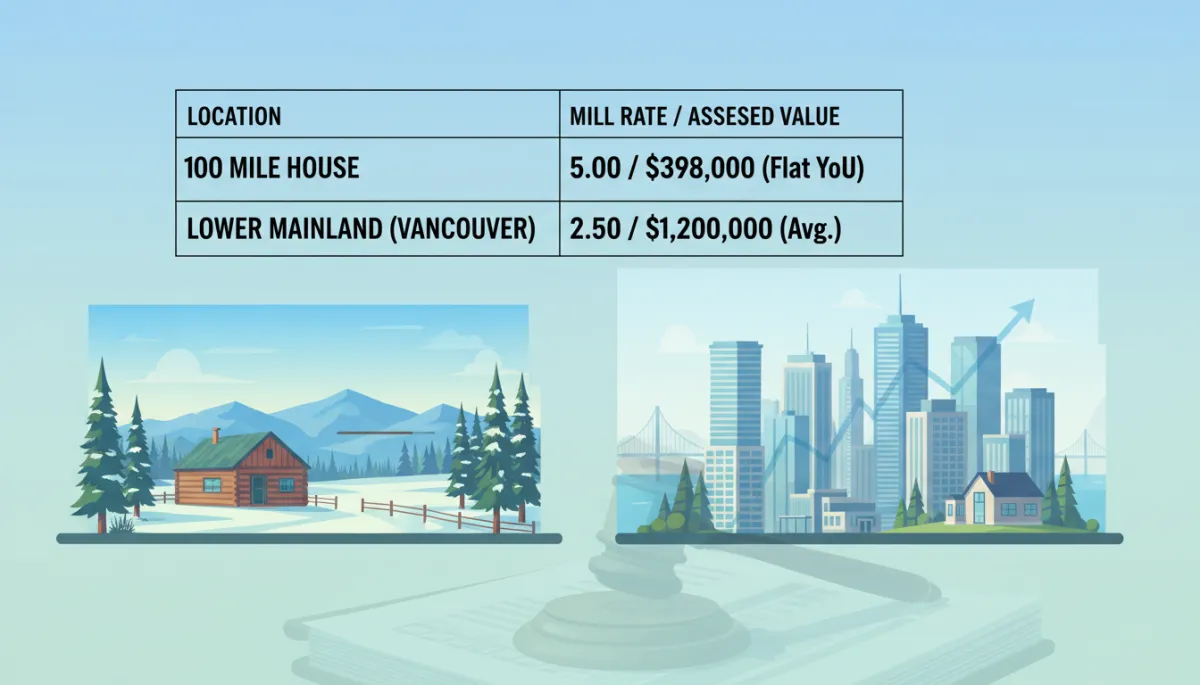
Property Taxes: 100 Mile House vs. Lower Mainland
Real Estate, Property Tax, British Columbia
Property Taxes in 100 Mile House vs. the Lower Mainland: Legal, Regulatory, and Rural Realities
Thinking about buying in 100 Mile House instead of the Lower Mainland? Understanding how mill rates, assessed values, and provincial rules interact can reveal why rural property taxes often feel lighter on paper and what that really means in practice.
Quick Numeric Comparison: Mill Rates and Sample Tax Bills (2026)
The table below compares the 2026 residential tax rates per $1,000 of assessed value and illustrates approximate annual taxes on a $398,000 home. For 100 Mile House, we use the provincial rural residential rate under the Taxation (Rural Area) Act, as the detailed municipal schedule is not publicly visible in the current bylaw extract.
Location 2026 Residential Rate
($ per $1,000) Assessed Value Used Approx. Annual Tax
(before grants & extras) 100 Mile House (provincial rural rate only) 0.3861* $398,000 ≈ $154 Vancouver 3.3639 $398,000 (for comparison) ≈ $1,338 Surrey 3.4273 $398,000 (for comparison) ≈ $1,364 Richmond 3.5384 $398,000 (for comparison) ≈ $1,408
*Provincial rural residential rate of $0.3861 per $1,000 under B.C. Reg. 387/82, as amended by Reg. 49/2026 (Taxation (Rural Area) Act Regulation). Actual total tax in 100 Mile House will be higher once municipal, regional district, hospital, and other levies are added, but still typically well below major urban centres.
100 Mile House: Flat Assessments, Rural Rates, and Local Bylaws
According to BC Assessment data reported by the 100 Mile Free Press in January 2026, the typical single‑family home in 100 Mile House is assessed at $398,000, and that value has remained flat year‑over‑year. Stable assessments mean that, unless tax rates change significantly, owners see relatively predictable bills from one year to the next.
Legally, property taxation in 100 Mile House is governed by a combination of:
The Community Charter and Local Government Act, which authorize municipalities to adopt annual tax rate bylaws.
The Taxation (Rural Area) Act, which sets the provincial rural mill rates, including the 2026 residential rate of $0.3861 per $1,000 of assessed value.
The District’s own Tax Rates Bylaw No. 1473 – 2026, which applies separate columns for general municipal purposes, debt, hospital, regional district services, recreation, and garbage collection.
📌 Key Takeaway: The provincial rural mill rate is only one piece of the puzzle. To calculate a true “all‑in” mill rate for 100 Mile House, you must add each line item in the District’s tax rates bylaw schedule, which is available directly from the municipality.
Lower Mainland: Higher Mill Rates, Higher Assessments, Denser Services
In the Lower Mainland, the story is the opposite: assessed values are typically far higher, and the comprehensive residential tax rates are roughly nine times the provincial rural rate. For 2026:
Vancouver’s total residential rate is about $3.3639 per $1,000 of assessed value.
Surrey’s is about $3.4273 per $1,000.
Richmond’s is about $3.5384 per $1,000.
These urban mill rates bundle multiple levies municipal, provincial school tax, transit (TransLink), Metro Vancouver, BC Assessment, and the Municipal Finance Authority. Legally, each of these is authorized under its own legislation, but for the homeowner they arrive as a single tax bill from the city. The higher rate reflects the cost of extensive urban services: rapid transit, dense road networks, policing, fire protection, and recreation facilities that simply do not exist at the same scale in small rural communities.

Side‑by‑side tax notices highlight how mill rates and services differ by region.
The Legal and Regulatory Framework Behind BC Property Taxes
Across both 100 Mile House and the Lower Mainland, several provincial laws shape how property taxes are calculated and how quickly they can grow:
Assessment Act: BC Assessment determines your property’s value as of July 1 each year. A 2026 amendment clarifies that private encumbrances (like certain covenants or private agreements) are not considered when setting assessed value, reinforcing long‑standing practice.
Budget 2026 rate‑setting rules: Starting in 2026, provincial school and rural tax rates are tied to the three‑year average change in provincial nominal GDP, not inflation. This affects both rural areas like 100 Mile House and urban centres, helping to smooth year‑to‑year changes.
Home Owner Grant and related benefits: The basic grant threshold is $2.075 million for 2026, and while the Northern and Rural Home Owner Benefit is being phased out from 2027, grants still reduce net taxes for many owner‑occupiers in both rural and urban BC.
Tax Deferment Program: From April 1, 2026, deferment loans for eligible owners carry interest at prime + 2%, compounded monthly. This can be a powerful tool for cash‑flow management, particularly for seniors in higher‑tax Lower Mainland markets.
💡 Pro Tip: Legal tools such as the Home Owner Grant and tax deferment can narrow the gap between rural and urban tax burdens on a cash‑flow basis, even when nominal mill rates differ dramatically.
Rural Properties in BC: Lower Rates, Different Trade‑Offs
For rural properties whether in 100 Mile House, the Cariboo more broadly, or other unincorporated areas the Taxation (Rural Area) Act Regulation sets distinct mill rates by property class. In 2026, residential rural properties pay just $0.3861 per $1,000, while farms, managed forest land, and recreational properties each have their own lower‑than‑urban rates. This framework recognizes that rural residents often receive fewer centralized services and may shoulder more responsibility for wells, septic systems, and road access.
However, “rural” does not always mean simple. A single rural property might straddle multiple jurisdictions municipal, regional district, and improvement districts for water or fire protection each with its own legal authority to levy taxes. That is why 100 Mile House’s official Tax Rates Bylaw splits rates into columns for hospital, regional district, recreation, and garbage collection: each service is grounded in a specific statute or inter‑local agreement.
What This Means for Buyers and Owners
For a home assessed at $398,000, the raw numbers suggest that 100 Mile House delivers a dramatically lower property tax bill than any of the major Lower Mainland municipalities. That advantage is amplified by the fact that the typical Cariboo home’s value is far below the multi‑million‑dollar assessments common in Vancouver, Surrey, and Richmond. Lower mill rates multiplied by lower assessed values produce much more manageable annual taxes.
The trade‑off is primarily about services, lifestyle, and long‑term planning. Rural property owners may drive farther for healthcare or shopping, rely on volunteer fire departments, and handle more on‑site infrastructure. Urban owners pay substantially more in taxes, but in return access rapid transit, dense amenities, and a broader range of public services costs that are built directly into those higher mill rates and assessments.
⚠️ Important: Before finalizing a purchase, always request the latest tax notice or contact the municipality or regional district directly. Bylaws and mill rates change annually, and only the current official schedule will give you an exact figure.