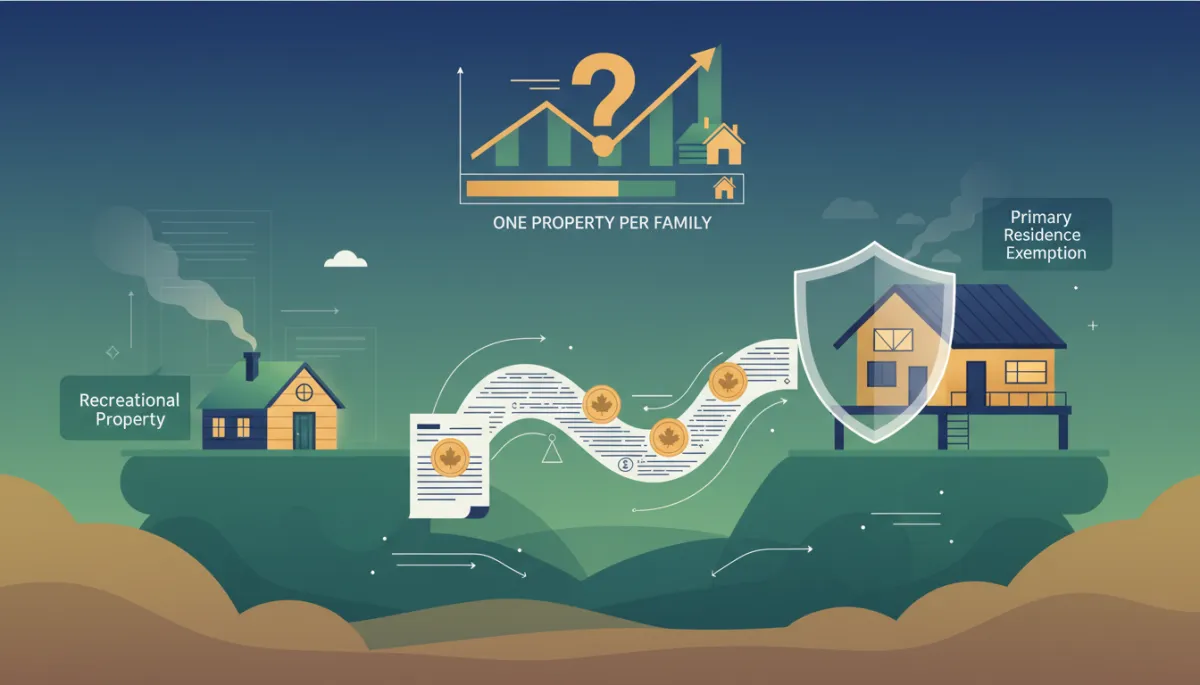
Recreational vs. Primary Residence Tax in Canada
Real Estate, Canadian Tax, Principal Residence Exemption
What’s the Difference Between a Recreational Property and a Primary Residence for Tax Purposes in Canada?
Thinking about the tax impact of selling your cottage or lake house? Here’s a clear, plain‑language FAQ on how Canada’s principal residence exemption applies to recreational properties and how it differs from your primary home. Rules cited are based on current CRA guidance as of 2026, but always confirm before filing.
Quick Answer: How Does the Principal Residence Exemption Work for a Cottage?
Under current Canada Revenue Agency (CRA) rules, a cottage or recreational property can qualify as your principal residence for a given tax year if:
it is a housing unit you own (such as a cottage or cabin),
you, your spouse/common‑law partner, or your child ordinarily inhabited it at some point during the year, and
you designate it as your principal residence for that year when you report the sale.
If those conditions are met, you may be able to shelter all or part of the capital gain on the cottage from tax using the principal residence exemption (PRE) (CRA). However, you cannot fully shelter both your city home and your cottage for the same year. Only one property per family unit per year can be designated for the PRE under current CRA guidance.
⚠️ This article is for general information only and is not legal or tax advice. Always confirm the latest CRA rules and consult a qualified tax professional before making decisions.
Recreational Property vs. Primary Residence: What’s the Tax Difference?
1. How the CRA Sees a Recreational Property
A recreational property is typically a cottage, cabin, or vacation home used mainly for personal enjoyment—weekends at the lake, ski trips, family gatherings. For income tax purposes, it is usually treated as personal‑use property. That means:
When you sell it, any increase in value is generally a capital gain.
Only 50% of the capital gain is taxable at your marginal tax rate (subject to any future legislative changes).
If it qualifies and is designated as your principal residence for some or all of the years you owned it, you may reduce or eliminate that taxable gain using the PRE.
Recreational properties can also trigger other taxes, depending on use and location for example, provincial/municipal property taxes and possible GST/HST or income tax implications if you rent it out short‑term. In British Columbia, for instance, recreational properties are often taxed at higher municipal rates than standard residential homes (BC property tax regulations).
2. How the CRA Sees a Primary Residence
Your primary residence (or principal residence in CRA language) is the home you choose to designate for a given tax year. It could be:
a city house or condo, or
a cottage or other recreational property that you and your family actually use and inhabit.
The key distinction is designation, not what you call the property. For tax purposes, a “primary residence” is simply the property you choose to designate as your principal residence for that year—subject to CRA rules on who lived there and how it was used (CRA folio on principal residence).
Deciding which property to designate can significantly change the tax on your cottage sale.
The Principal Residence Exemption for Cottages: Key Rules
1. Yes, a Cottage Can Be Your Principal Residence
The CRA clearly states that a cottage qualifies as a principal residence if it is a housing unit you own and you or your spouse/partner or child ordinarily inhabit it during the year (CRA guidance). “Ordinarily inhabited” does not require year‑round occupancy regular seasonal use can be enough.
2. Only One Property per Family Can Claim the Exemption Each Year
Under current CRA rules, only one property per family unit can be designated as the principal residence for a particular tax year. A family unit generally includes you, your spouse or common‑law partner, and any minor children (CRA folio S1‑F3‑C2).
If you own both a city home and a cottage, you must decide which one to designate for each year when you sell one of them.
You can split years some years designated to the house, others to the cottage to optimize your overall tax outcome, using the CRA’s formula and “plus‑1” rule.
This is where professional advice becomes crucial. The decision about which property to designate in which years can change your total tax bill by tens of thousands of dollars, especially if your cottage has appreciated significantly.
3. Land and Partial Use Rules for Cottages
When a cottage qualifies as your principal residence, the exemption normally covers the building and up to about ½ hectare (1.24 acres) of land. A larger parcel may be allowed if you can show it is necessary for the use and enjoyment of the property such as where local bylaws require a minimum lot size (CRA principal residence rules).
If you rent out the cottage for part of the year, or use a portion for business (for example, a home office), the CRA may treat part of the property as income‑producing. In that case, some of the gain may not qualify for the exemption unless:
the income‑producing use is minor or ancillary to personal use,
there are no structural changes, and
you have not claimed capital cost allowance (CCA) on the cottage.
Recreational Property Tax in Canada: Beyond the PRE
The principal residence exemption is only one part of the tax picture. When you own a recreational property in Canada, you may also need to consider:
Municipal and provincial property taxes, which can be higher for recreational or non‑primary properties (for example, BC’s higher Class 8 rate for recreational property compared with Class 1 residential).
GST/HST considerations if you operate short‑term rentals stays under one month are generally taxable, and non‑compliance with local rules can now limit your expense deductions under federal changes effective 2025 (CRA rental guidance).
Potential application of the Underused Housing Tax or provincial vacancy/“speculation” taxes if the property is rarely occupied and located in certain jurisdictions.
Reporting the Sale of a Cottage or Primary Residence
Since the 2016 tax year, the CRA requires you to report the sale of any principal residence including a cottage if you want to claim the exemption. This generally means completing:
Schedule 3 (Capital Gains or Losses), and
Form T2091(IND), the designation of a property as a principal residence by an individual.
If you fail to report the sale and make the designation, the CRA can deny the exemption and assess penalties, even if you would otherwise have qualified (CRA capital gains guide).
Why You Should Talk to a Tax Professional Before You Sell
Choosing whether to treat your cottage as a recreational property subject to regular capital gains tax, or to designate it as your principal residence for some or all years, is a strategic planning decision. The right answer depends on:
how much each property (home and cottage) has increased in value,
how long you have owned each one,
whether either property was rented or used for business, and
your broader financial and estate‑planning goals.
Because only one property per family can claim the principal residence exemption in a given year, and because rules around change of use, short‑term rentals, and anti‑flipping are evolving, it is strongly recommended that you consult a Canadian tax professional such as a CPA, tax lawyer, or experienced planner before you sell a cottage or designate any property as your principal residence. They can model different scenarios and help you comply with the latest CRA requirements.
Tax rules change, and individual situations can be complex. Before you file, always verify current CRA guidance on the principal residence exemption and recreational property tax, and get personalized advice tailored to your family’s circumstances.